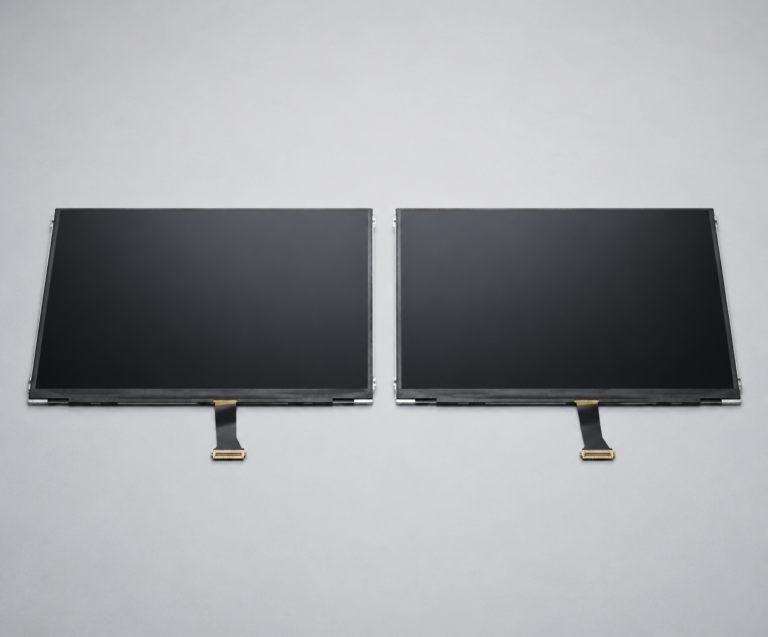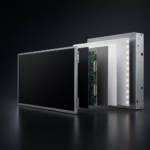
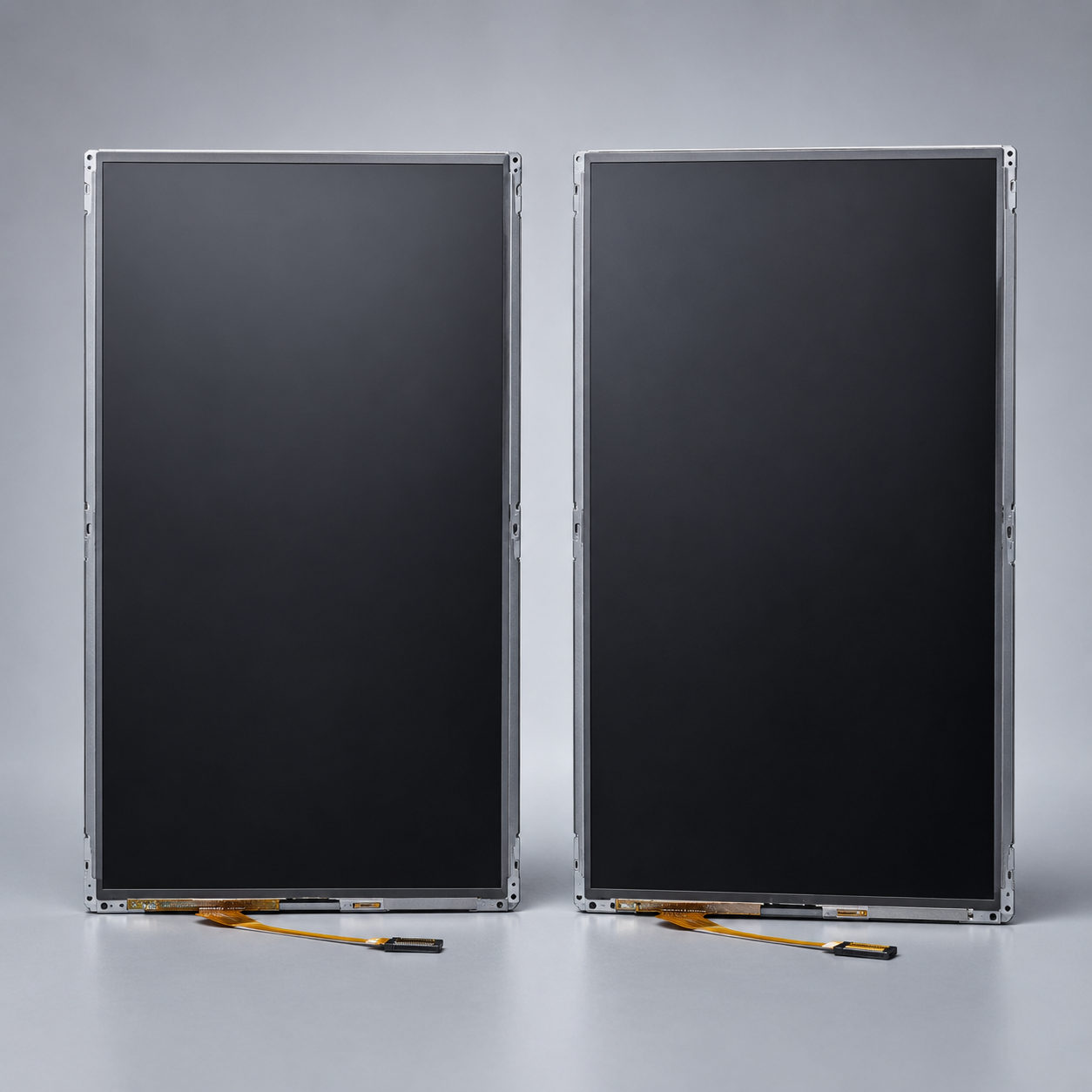

The AUO T215HVN05.1 and BOE HR215WU1-120 are two 21.5-inch FHD LVDS panels that suit the same indoor terminals, but they are built on different LCD technologies: the T215HVN05.1 is a VA panel rated at 3000:1 contrast, while the HR215WU1-120 is an ADS wide-view panel at 1000:1. Both run 1920×1080 at 250 cd/m² over a 30-pin LVDS interface, so the choice comes down to contrast versus viewing angle. This guide from Vernon Tech (Guangzhou Wanhong Electronic Technology Co., Ltd.) compares the two for kiosk, POS and panel-PC integration.
Published: June 2026 · Last updated: 1 June 2026
What are the AUO T215HVN05.1 and BOE HR215WU1-120?
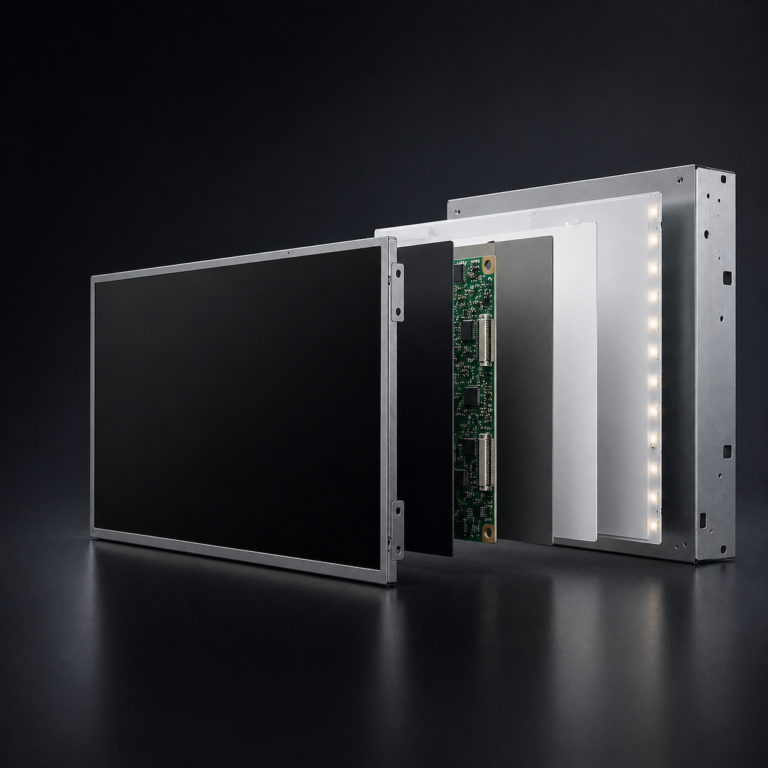
The T215HVN05.1 and HR215WU1-120 are 21.5-inch Full HD (1920×1080) a-Si TFT-LCD display modules with a 476×268 mm active area, 250 cd/m² typical brightness, 72% NTSC color, a 75 Hz refresh rate and a 30-pin LVDS (2-channel, 8-bit) interface on a 5.0 V supply. The T215HVN05.1 is made by AUO (AU Optronics) and uses a VA panel; the HR215WU1-120 is made by BOE (BOE Technology) and uses an ADS panel. Both ship without touch and share a 17S4P WLED backlight rated for 30,000 hours.
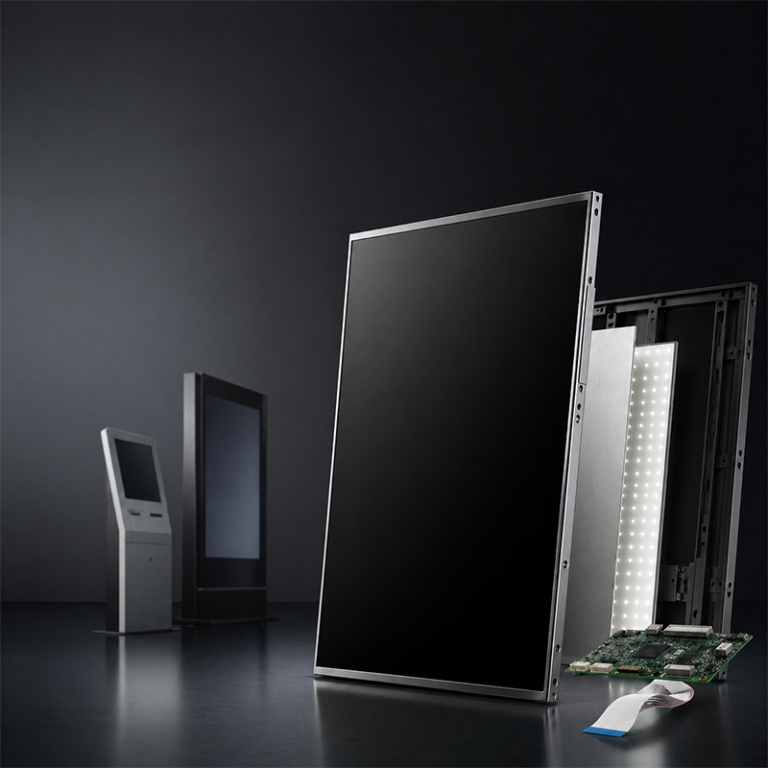
In a real build, the panel is the visual core of a larger terminal. An integrator still has to confirm the LVDS cable, embedded controller or mainboard, inverter-free WLED driving, cover lens and mechanical housing before sampling.
Both are indoor panels. At 250 cd/m² neither is sunlight-readable, the interface is LVDS rather than eDP, and the 0 °C to +50 °C operating range means neither is an industrial wide-temperature part.
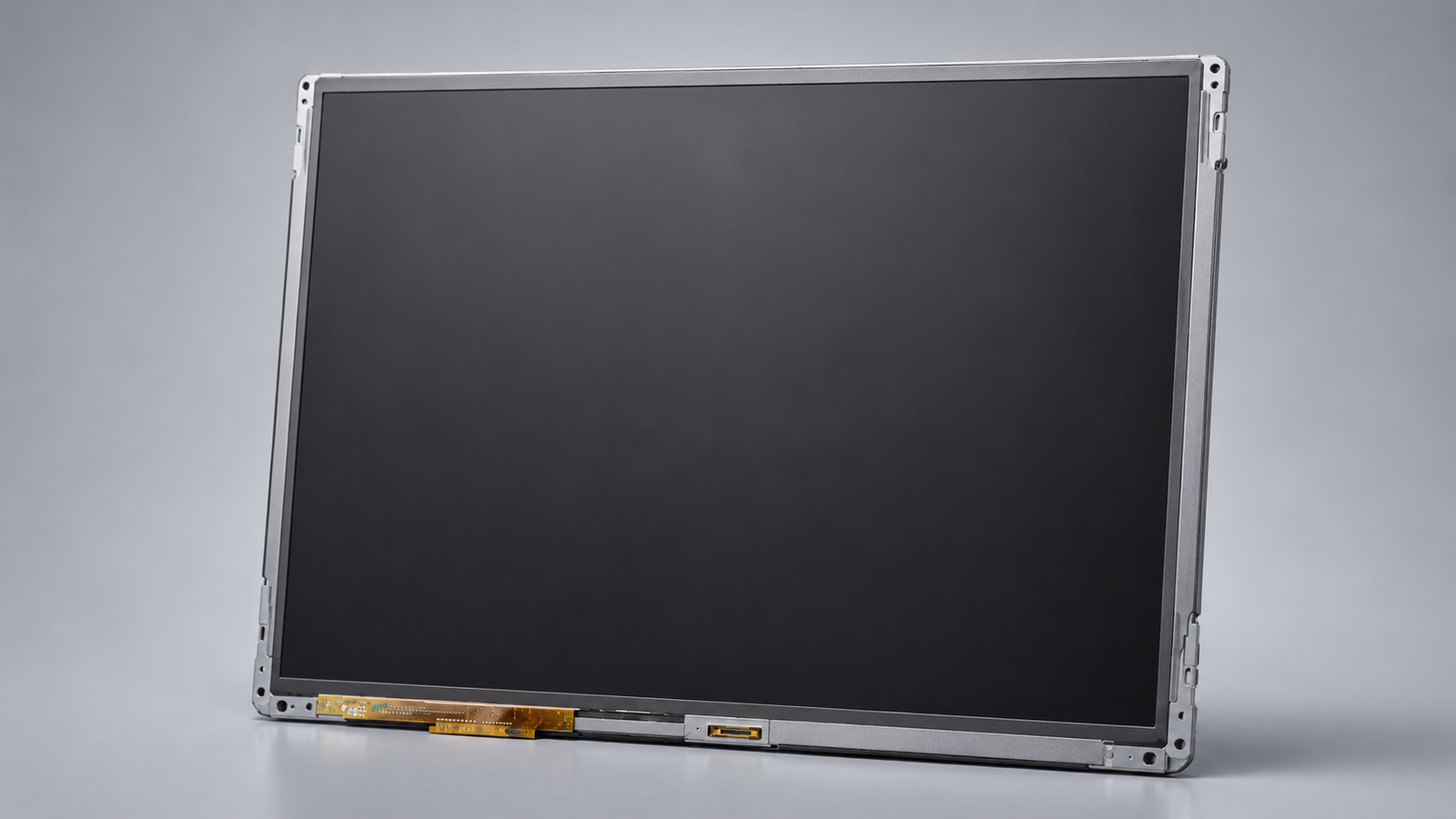
VA vs ADS: what actually separates these two panels
The core difference is the LCD panel technology, which drives the contrast-versus-viewing-angle trade-off. Everything else — resolution, brightness, interface, backlight life — is effectively the same.
T215HVN05.1 — VA, high contrast
VA (vertical alignment) gives the T215HVN05.1 a 3000:1 typical contrast ratio, deep blacks and strong on-axis image depth. It is the better choice when a single user faces the screen, when the room is dim, or when image contrast matters more than off-axis consistency. The trade-off is more color and gamma shift when viewed from a sharp angle.
HR215WU1-120 — ADS, wide viewing
ADS (a BOE wide-viewing-angle technology comparable to IPS) holds color and brightness consistent across wide angles, which suits public, multi-viewer or off-axis terminals. Its contrast is lower at 1000:1, but the image stays stable when several people view it from the side.
T215HVN05.1 vs HR215WU1-120: full specification comparison
The two panels match on most core specifications and differ mainly in panel technology, contrast, mechanical outline and weight. The figures below are taken from the panel data, not estimated.
| Specification | AUO T215HVN05.1 | BOE HR215WU1-120 |
|---|---|---|
| Brand | AUO (AU Optronics) | BOE (BOE Technology) |
| Panel size | 21.5 inch | 21.5 inch |
| Panel type | a-Si TFT-LCD module | a-Si TFT-LCD module |
| Optical mode | VA, normally black | ADS, normally black |
| Resolution | 1920×1080 FHD, 16:9 | 1920×1080 FHD, 16:9 |
| Active area | 476.064×267.786 mm | 476.64×268.11 mm |
| Outline (W×H×D) | 484.5×284.4×13.38 mm | 495.6×292.2×11.3 mm |
| Weight (typ) | 1.58 kg | 1.79 kg |
| Brightness (typ) | 250 cd/m² | 250 cd/m² |
| Contrast (typ) | 3000:1 | 1000:1 |
| Viewing angle (typ) | 89/89/89/89 | 89/89/89/89 |
| Colors / gamut | 16.7M, 72% NTSC | 16.7M, 72% NTSC |
| Response (typ) | 13/5 ms (Tr/Td), 20 ms G-to-G | 14 ms (Tr+Td) |
| Surface treatment | Anti-glare + hard coat (3H) | Anti-glare + hard coat (3H) |
| Refresh | 75 Hz | 75 Hz |
| Interface | LVDS 2-ch, 8-bit, 30-pin | LVDS 2-ch, 8-bit, 30-pin |
| Backlight | 17S4P WLED, 30K h, no driver | 17S4P WLED, 30K h, no driver |
| Power (typ) | 12.7 W | 10.21 W (14.26 W max) |
| Supply voltage | 5.0 V (typ) | 5.0 V (typ) |
| Touch | None | None |
| Operating / storage temp | 0–50 °C / -20–60 °C | 0–50 °C / -20–60 °C |
| Second-source | 5 cross-compatible models listed | — |
Note: model code, interface and supply form should always be confirmed against the current data sheet before quotation. Tell Vernon Tech whether you need the open module, a panel-plus-cable kit, or a touch-integrated assembly.
Which 21.5″ panel should you specify?
Specify the T215HVN05.1 (VA) when contrast and image depth matter most, and the HR215WU1-120 (ADS) when wide, consistent viewing angles matter most. Because the two share resolution, interface and active area, the decision is mostly about how the screen will be viewed.
Choose the AUO T215HVN05.1 (VA) for
Single-user kiosks, payment terminals and panel PCs in controlled or dim lighting where deep blacks and 3000:1 contrast improve the image. It is also the lighter (1.58 kg) and smaller-footprint option, and it lists five cross-compatible models, which helps second-source planning.
Choose the BOE HR215WU1-120 (ADS) for
Public, multi-viewer and off-axis terminals — POS displays, queue and information screens, shared panel PCs — where several people read the screen from the side and color consistency beats peak contrast. Its thinner 11.3 mm profile also suits slimmer enclosures.
If you are matching an existing 21.5-inch design, send the original part number and your housing dimensions so Vernon Tech can confirm fit and the LVDS pinout before sampling.
If neither fits: related and upgraded solutions
If your project needs more than a standard indoor 21.5″ LVDS panel, Vernon Tech can match an adjacent solution rather than force-fit one of these two. The most common requests are touch, higher brightness and a different size.
Add touch
Neither panel includes touch. For interactive kiosks and POS, Vernon Tech can pair either panel with a PCAP touch sensor, controller and cover lens as a bonded touch kit.
Need more brightness or another size
For semi-outdoor or sunlit installations, 250 cd/m² is not enough — ask about high-brightness 300–700 nit modules. For other sizes, compare the 15.6-inch NV156FHM eDP panels or the BOE QV185FHB-N82 18.5-inch open cell, or browse the full BOE and AUO LCD module range.
OEM / ODM display assemblies
Vernon Tech supports OEM/ODM builds: panel plus LVDS cable, controller board, backlight tuning, cover lens and housing delivered as a tested assembly. Follow display industry updates for panel availability and roadmap changes.
Get a quote on the T215HVN05.1 or HR215WU1-120
Vernon Tech (Guangzhou Wanhong Electronic Technology Co., Ltd.) is a Guangzhou-based B2B supplier of original BOE and AUO display panels, serving kiosk, POS, panel-PC and digital-signage integrators worldwide with OEM/ODM service, USD pricing and CE / FCC / UKCA / SASO documentation by destination.
Send your application, target quantity and how the screen will be viewed, and Vernon Tech will confirm whether VA or ADS fits and reply with a USD quotation within 12 hours.
Request a USD quote & data sheet
- ✅ Factory-direct BOE & AUO panels — OEM / ODM supported
- 💰 USD pricing & worldwide shipping
- ⏱️ Reply within 12 hours
- 📦 Bulk orders & samples available
- 📝 CE / FCC / UKCA / SASO certificates by destination
📱 Chat on WhatsApp
Frequently asked questions
What is the difference between the AUO T215HVN05.1 and BOE HR215WU1-120?
Both are 21.5-inch FHD LVDS panels at 250 cd/m², 72% NTSC and 75 Hz. The T215HVN05.1 is an AUO VA panel with 3000:1 contrast for deeper blacks; the HR215WU1-120 is a BOE ADS wide-view panel with 1000:1 contrast and more consistent off-axis color.
Should I choose VA or ADS for a 21.5-inch terminal?
Choose VA (T215HVN05.1) for single-user, dim-room or high-contrast use; choose ADS (HR215WU1-120) for public, multi-viewer or off-axis screens where color must stay consistent across wide angles.
Can I swap the T215HVN05.1 for the HR215WU1-120 in my existing 21.5-inch design?
Electrically they are close: same 1920×1080 resolution, LVDS 2-channel 8-bit 30-pin interface, 5.0 V supply and ~476×268 mm active area. But the outline and weight differ (484.5×284.4×13.38 mm / 1.58 kg vs 495.6×292.2×11.3 mm / 1.79 kg), so verify housing clearance and mounting before swapping.
Do these panels use eDP, or do I need an LVDS board?
No. Both use LVDS (2-channel, 8-bit, 30-pin) on a 5.0 V supply, not eDP. Confirm your controller or mainboard outputs LVDS before specifying either model.
Can I use these 21.5-inch panels outdoors?
No. At 250 cd/m² both are indoor panels and are not readable in direct sunlight. For semi-outdoor or sunlit use, ask Vernon Tech about high-brightness 300–700 nit modules instead.
Do these panels support touch, or do I need to add it?
No, both ship without touch. For interactive use, Vernon Tech can supply a bonded PCAP touch kit with controller and cover lens matched to the panel.
What lead time and MOQ can I expect?
MOQ and lead time depend on quantity and supply form (open module, panel-plus-cable kit, or touch assembly). Vernon Tech replies within 12 hours with a confirmed USD quotation, and supports both sample orders and bulk production.